Pricing Without Capacity Insight Is Guesswork
.png)
Pricing is often treated as a commercial decision. It is discussed in leadership meetings alongside positioning, value, competition and client expectations. Firms compare market rates, analyse fee sensitivity, and debate how far they can push increases without resistance.
But beneath all of that, pricing is fundamentally an operational decision.
If you do not have a clear understanding of how work actually moves through your firm - how long it takes, where it stalls, who carries it, and how capacity fluctuates throughout the year - then pricing is not strategic. It is speculative.
You may be right. You may even be profitable. But you are still guessing.
And as firms grow, guessing becomes increasingly expensive.
When Revenue Rises but Margins Do Not
Many firms experience a frustrating pattern. Fees are increased. Revenue grows. The top line looks stronger than the previous year. Yet profitability does not improve in proportion, and operational pressure remains constant.
Teams still feel stretched during peak periods. Review bottlenecks still form. Certain service lines continue to overrun. Senior staff absorb overflow work to keep delivery on track.
At that point, leadership often concludes that pricing was not aggressive enough, or that the firm needs to improve efficiency, or that hiring is the next step.
All three may be partially true. But none address the underlying issue if there is no clarity on the real cost of delivery.
Pricing cannot compensate for structural inefficiency that has not been identified. In fact, it often masks it.
The Myth of Market-Based Pricing
Most firms rely on some combination of the following when setting fees:
- Benchmarking against competitors
- Applying annual percentage uplifts
- Moving toward fixed or value pricing models
- Adjusting fees based on client size or perceived complexity
- Drawing on partner experience and historical precedent
These methods provide useful signals. However, they do not answer the most critical question:
What does it actually cost the firm, in time and capacity, to deliver this service well?
Without an evidence-based answer to that question, pricing discussions are built on memory, anecdote and instinct. That might be workable in a very small team where partners are deeply embedded in delivery. It becomes far more fragile in a growing firm with multiple layers of delegation and review.
Growth Increases the Cost of Assumption
In the early stages of a firm’s development, partners have a direct line of sight into delivery. They see which clients are demanding. They know which jobs feel heavy. They are personally involved in review and client communication.
As the firm expands, that visibility fades. Work is distributed across teams. Review stages multiply. Communication flows through several people before reaching a partner. Delivery becomes more complex.
Without structured operational visibility, growth conceals inefficiencies. Revenue can increase while margin silently compresses. Capacity strain can build unevenly across roles. High performers can absorb disproportionate effort without it being immediately obvious in headline reports.
In that environment, pricing decisions that rely on instinct become increasingly risky. The further leadership sits from the mechanics of delivery, the more important it becomes to ground pricing in operational data.
Capacity Is the Missing Variable
Every firm operates within a finite pool of time and expertise. Capacity is not abstract; it is defined by the hours and cognitive bandwidth of the people in your team.
Each new client engagement, advisory service, or expanded scope consumes that capacity. If you cannot clearly see how much of it is already committed, you cannot accurately assess whether a proposed fee aligns with the real cost of delivery.
Pricing without capacity insight creates three common outcomes. The first is underpricing, where fees look attractive but the internal effort required to deliver erodes margin. The second is reactive hiring, where additional staff are brought in to relieve pressure without addressing the structural causes of overload. The third is uneven workload distribution, where certain individuals carry disproportionate strain because bottlenecks are not visible in advance.
None of these are solved by adjusting the headline fee alone. They require clarity on how work is structured and resourced.
What Data-Driven Pricing Requires
If pricing is to move from assumption to precision, it must be informed by operational insight. That means going beyond total hours logged and examining patterns across workflows and service lines.
First, firms need a clear view of actual delivery time by service type over a meaningful period. Not theoretical estimates, but real data. This should include preparation time, review time, client communication and rework. When a service consistently exceeds its estimate, that pattern is not random; it reflects either flawed scoping or friction within the workflow.
Second, firms should examine where overruns occur. If work repeatedly stalls at review, or if certain stages of a process require significantly more effort than planned, that insight should influence pricing or process redesign. Ignoring those signals simply embeds inefficiency into future engagements.
Third, reactive work must be visible. Ad hoc client queries, document chasing, and informal advisory conversations often consume more time than firms realize. When these hours are absorbed without structured tracking, pricing models fail to account for them.
Finally, workload distribution across roles matters. If senior staff routinely complete tasks that could be delegated, the cost base of delivery shifts upward. Pricing that assumes a different allocation of effort will inevitably miss the mark.
The Limitations of Fragmented Systems
Many firms attempt this level of analysis through manual reporting. They export time data into spreadsheets, cross-reference it with revenue reports, and attempt to build margin models externally.
The challenge is not capability but cohesion. When workflow management, time tracking, task allocation and capacity planning live in separate systems, analysis becomes slow and retrospective. By the time patterns are identified, decisions have already been made and pressure has already been felt.
What firms need is an integrated view of work and capacity. When time is directly connected to structured workflows, and when workload is visible across the team in real time, leadership can see how delivery effort accumulates and where strain develops.
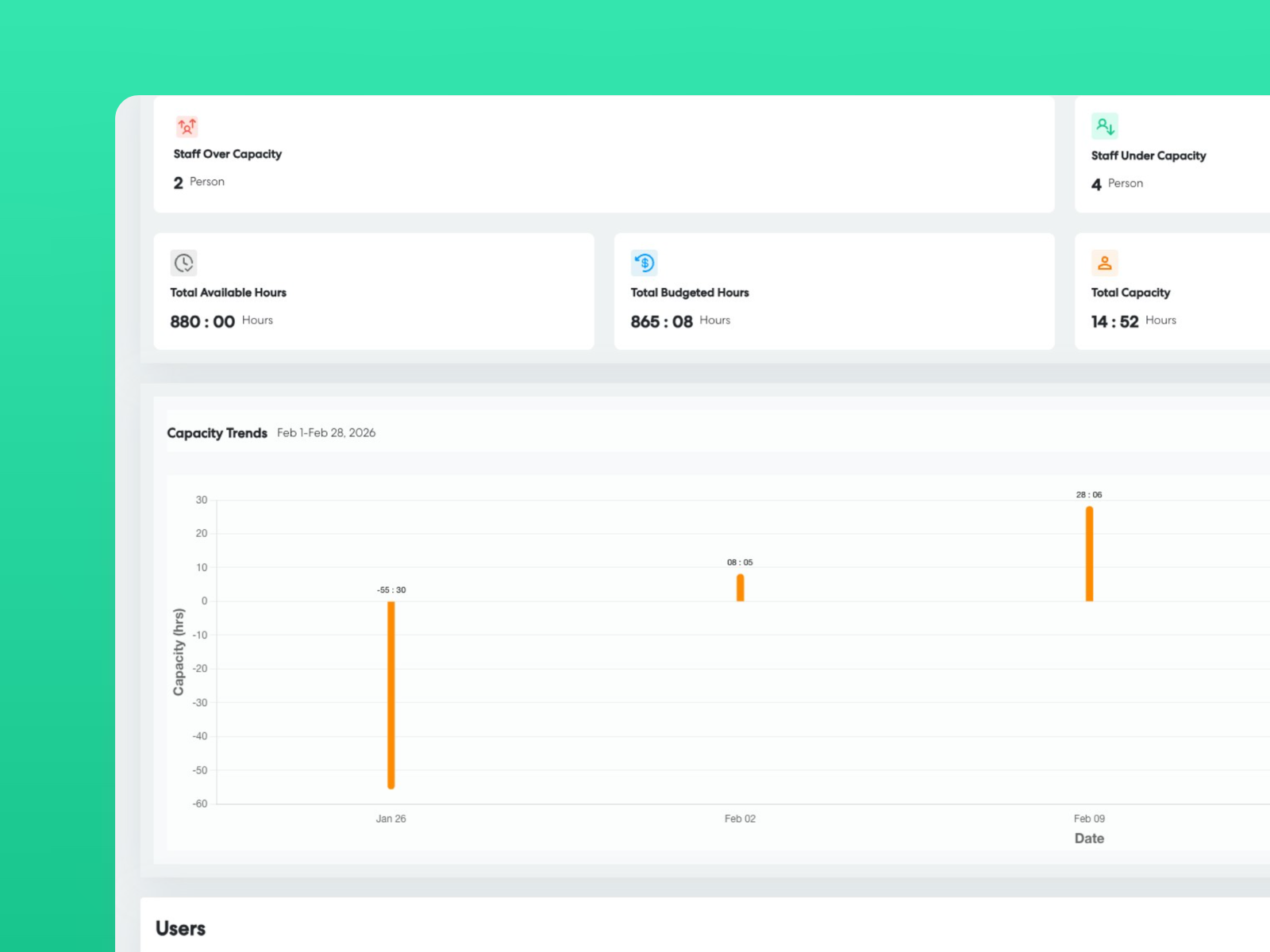
This is where infrastructure becomes strategic. A platform like Levvy centralizes client work, ties time directly to defined workflows, and provides visibility into capacity and performance across the firm. Instead of stitching together disconnected reports, leaders can examine how service lines perform in practice and how resource allocation affects margin.
With that level of visibility, pricing discussions change in tone and substance. They shift from “What can we charge?” to “What does this service truly require to deliver sustainably and profitably?”
Pricing as a Controlled Lever
When operational insight supports pricing decisions, leadership gains control rather than relying on correction. Fees can be adjusted based on clear patterns rather than general fatigue. Workflows can be redesigned before price increases are implemented. Hiring can be planned with foresight rather than urgency.
Most importantly, growth becomes intentional. The firm can expand services, onboard clients and introduce advisory offerings with a clear understanding of how each decision affects capacity and margin.
Without that clarity, pricing remains reactive. It becomes a tool for patching pressure rather than guiding strategy.
From Guesswork to Confidence
The firms that scale effectively are not necessarily those with the most aggressive pricing strategies. They are the ones with the clearest operational insight.
They understand the relationship between time, workflow, capacity and profitability. They recognize that commercial success depends on structural visibility. And they build systems that support evidence-based decisions rather than instinct.
If pricing decisions in your firm are not grounded in integrated insight into time and capacity, there is likely hidden risk embedded in your margins.
Levvy is designed to eliminate that blind spot. By bringing client work, workflow management, time tracking and capacity visibility into one centralized platform, Levvy enables accounting firms to align pricing with operational reality.
If you are ready to move beyond assumption and build a pricing strategy informed by how your firm actually operates, learn more about how Levvy supports data-driven decision-making at levvy.com.
.png)
.png)
.png)