The KPIs That Actually Help You Manage a Growing Accounting Firm
.png)
As accounting firms grow, leadership becomes less about technical expertise and more about operational visibility. In a smaller firm, partners can sense pressure points almost instinctively. They know which client is demanding, which staff member is stretched, and which jobs are falling behind. That intuition works when work is visible and proximity is close.
Once a firm scales beyond a handful of people, however, instinct stops being reliable. Delivery becomes layered, responsibilities are distributed, and partners are no longer directly involved in every engagement. At that stage, performance must be managed through data rather than feel. The challenge is that many firms track the wrong metrics.
Revenue growth, total billable hours, and net income are important, but they are lagging indicators. They tell you what already happened. If your goal is to lead a growing firm confidently, you need KPIs that reveal what is forming beneath the surface before it affects margin, staff morale, or client experience.
Below are the KPIs that matter most for US accounting firms that want to scale deliberately rather than reactively.
1. WIP Days: The Speed of Your Workflow
Work-in-progress days, often referred to as WIP days or revenue lock-up, measure how long work sits in the system before it is billed. It is one of the most overlooked yet revealing metrics in professional services firms.
In practical terms, WIP days indicate how efficiently effort converts into revenue. High WIP days often signal stalled reviews, unclear ownership, inconsistent billing practices, or jobs that remain open longer than necessary. According to benchmarking surveys used by US firms, WIP days are a core measure of operational health because they link workflow performance directly to cash flow.
When WIP days climb, the problem is rarely billing discipline alone. More often, it reflects friction inside the delivery process. Jobs may be waiting for partner review, or staff may be juggling too many engagements simultaneously. Without visibility into workflow stages, WIP accumulates quietly until it affects cash and margin.
Managing WIP days effectively requires more than running a report at month-end. It requires structured visibility into where work is sitting, who owns it, and how long it has been idle.
2. Realization Rate: Are You Capturing the Value of Your Effort?
Realization, or recoverability, measures how much of the time recorded actually converts into billed and collected revenue. It exposes the gap between effort and income.
Many firms track total hours and total billings but fail to connect the two meaningfully. When realization drops, it often reflects underpricing, scope creep, or inefficiencies within the workflow that generate excess time without proportional revenue.
For example, if a tax engagement consistently exceeds estimated hours but billing remains fixed, realization erodes. Over time, this compresses margin even when revenue appears steady. Realization is therefore not simply a billing metric; it is a pricing and process metric.
US practice management guidance consistently emphasizes realization as a central performance indicator because it connects operational execution to financial outcome. However, realization should not be viewed in isolation. It must be analysed alongside service type, client segment, and workflow performance to identify structural issues.
3. Utilization Rate: Activity with Context
Utilization measures the proportion of available time spent on billable work. It is one of the most commonly referenced KPIs in accounting firms and remains useful when interpreted carefully.
High utilization can indicate strong productivity, but it can also conceal inefficiency. A team member may log significant billable hours while operating within a flawed workflow that requires rework or unnecessary escalation. Conversely, moderate utilization may reflect intentional capacity planning that protects quality and client service.
The key is to view utilization in context. Benchmarking surveys of US CPA firms show variation in utilization by firm size and role, but the real value lies in understanding patterns across your own firm. Are certain roles consistently over-utilized while others have slack? Does utilization spike before deadlines due to poor forward planning?
When utilization is connected to real-time workload visibility rather than retrospective timesheets alone, it becomes a proactive management tool rather than a historical statistic.
4. Revenue per Employee and Partner Leverage: Structural Efficiency
Revenue per employee and staff-to-partner leverage ratios are widely cited in US benchmarking surveys such as the AICPA MAP Survey and IPA Practice Management reports. These metrics assess how effectively a firm’s structure supports growth.
Revenue per employee indicates how well human capital is monetized. If revenue grows without a corresponding increase in revenue per employee, the firm may be adding complexity without efficiency.
Partner leverage, typically expressed as staff-to-partner ratio, reflects how work is distributed across seniority levels. Firms with healthy leverage ensure partners focus on high-value advisory, business development, and leadership rather than routine execution.
However, leverage metrics only become meaningful when linked to workflow data. If partners are stepping into jobs late due to bottlenecks or unclear delegation, leverage ratios may look acceptable on paper while structural inefficiencies persist.
5. Days Sales Outstanding (DSO): Cash Discipline
Profit does not pay salaries; cash does. Days Sales Outstanding measures how long it takes to collect payment after invoicing and is a fundamental cash-flow KPI in US firms.
High DSO can indicate billing delays, unclear engagement terms, weak collections processes, or client dissatisfaction. When DSO is combined with WIP days, leadership gains a clearer picture of total revenue lock-up from job start to cash receipt.
Effective management of DSO requires alignment between billing cadence, client communication, and operational delivery. If invoices are delayed because jobs remain technically incomplete in the system, the issue is operational, not administrative.
6. Job Turnaround Time and Workflow Cycle Time
Job turnaround time measures the elapsed time from initiation to completion. Unlike total hours logged, cycle time reveals where work slows.
If advisory engagements take significantly longer to complete than planned, or if compliance work stalls at review stages, cycle time exposes these bottlenecks clearly. This is especially critical in growing firms where multiple layers of review and coordination exist.
Cycle time is a leading indicator. It shows strain before margin suffers. It reveals friction before burnout appears. And it highlights process instability before client complaints arise.
Tracking cycle time effectively requires centralized workflow management. Without visibility into task stages and job ownership, identifying delays becomes guesswork.
Leading Indicators Versus Lagging Indicators
Many firms rely primarily on lagging indicators such as revenue growth and net profit margin. While these are essential, they do not provide early warning.
Leading indicators such as WIP days, realization trends, utilization patterns, and cycle time reveal structural tension early. They allow leadership to adjust workflow design, rebalance capacity, and refine pricing before financial damage occurs.
The difference between a reactive firm and a strategically managed firm often lies in this distinction.
Why Infrastructure Matters
Tracking these KPIs manually through exported spreadsheets is possible but inefficient. Fragmented systems make it difficult to connect time, workflow, and financial performance in a cohesive way.
For KPIs to drive decisions rather than sit in reports, they must be visible within the daily operating environment. Leadership should be able to see workload distribution, overrun patterns, and service-level profitability without assembling data from multiple tools.
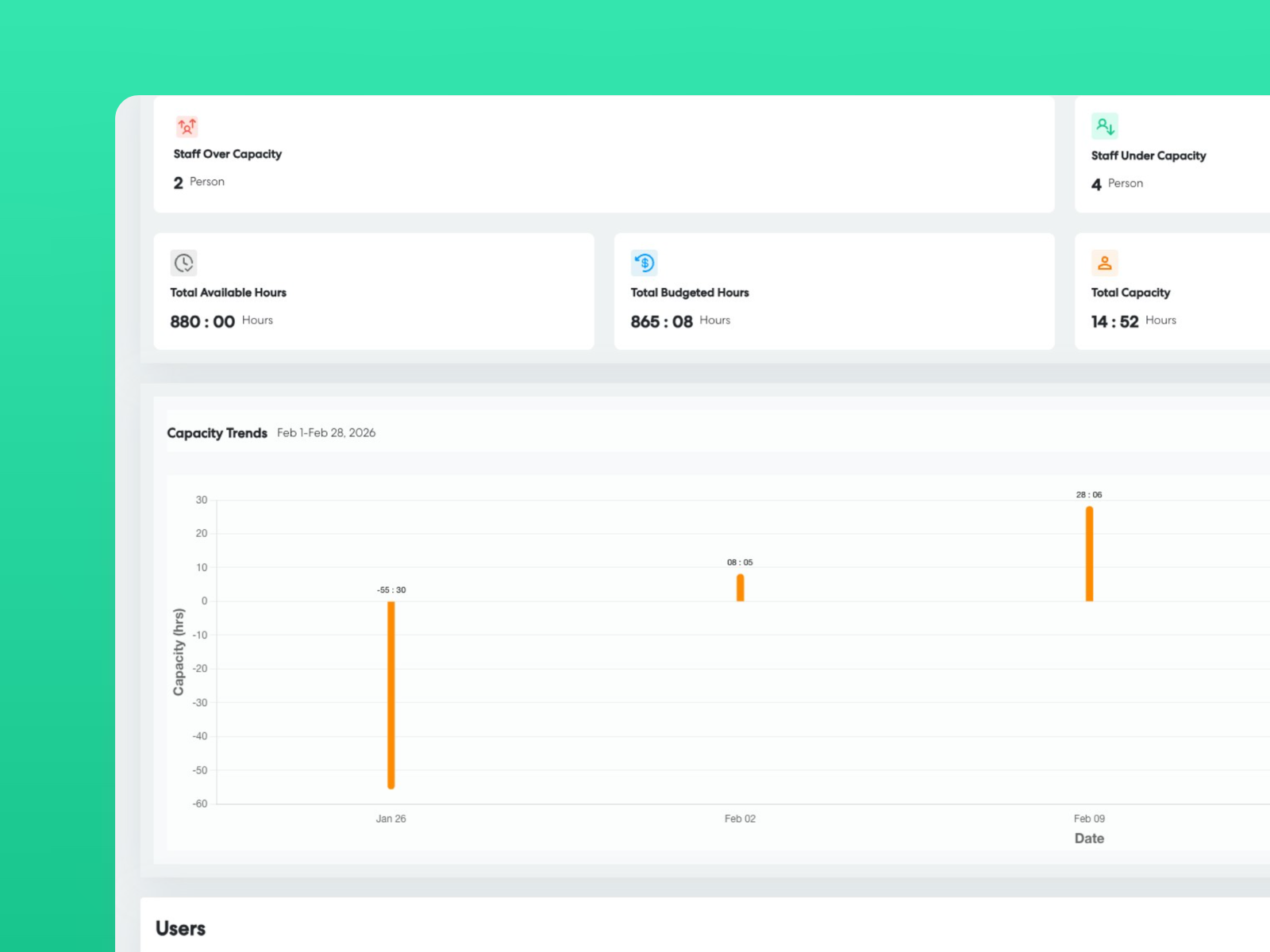
This is where operational infrastructure becomes strategic. Levvy centralizes client work, connects time directly to structured workflows, and provides real-time visibility into capacity and performance across the firm. When KPIs are embedded into the system where work happens, insight becomes continuous rather than periodic.
Instead of asking at quarter-end why margin compressed, leaders can see the signals forming in real time.
Managing a Firm at Scale Requires Visibility
The firms that grow sustainably are not those that simply track more metrics. They are the ones that track the right metrics and understand how those metrics interconnect.
WIP days reflect workflow velocity. Realization reflects pricing alignment. Utilization reflects capacity deployment. DSO reflects cash discipline. Revenue per employee reflects structural efficiency. Cycle time reflects process stability.
Together, these KPIs form a coherent view of operational health.
If your current systems do not make these relationships visible, leadership decisions will rely too heavily on instinct. As firms scale, instinct alone is not enough.
Levvy is designed to give US accounting firms that level of integrated visibility. By bringing workflow management, time tracking, capacity insight, and reporting into one platform, Levvy enables leaders to manage performance proactively rather than retrospectively.
If you want your KPIs to drive confident decisions rather than simply populate dashboards, learn more about how Levvy supports operational clarity at levvy.com.
.png)
.png)
.png)